Knife Skills for Beginners: The Basic Cuts Every Home Cook Should Know

Chef Karim
CHEF
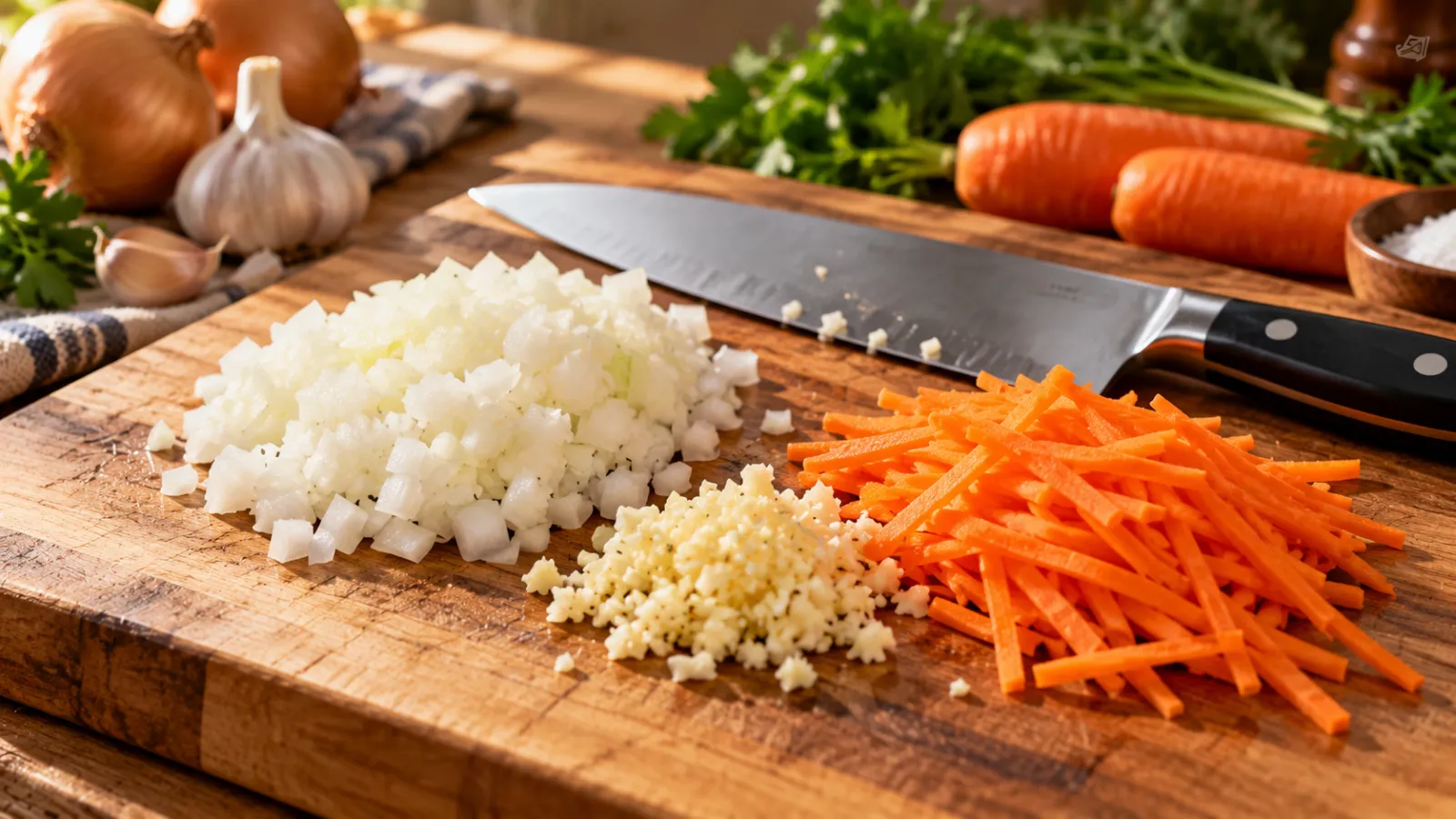
Good knife skills are the quiet foundation of good cooking. When vegetables are cut to the same size, they cook at the same rate, so you do not end up with some pieces burnt and others raw. Prep goes faster, recipes feel less like a chore, and, perhaps most importantly, you are far less likely to cut yourself.
You do not need a drawer full of specialty blades. One sharp chef's knife, around 8 inches (20 cm) long, a sturdy cutting board, and a little practice will cover almost everything a home cook does. Here are the grips, cuts and habits worth learning first.
Set up your station
Start with a cutting board that is large enough to hold what you are cutting with room to spare. Wood or plastic is ideal; glass, stone and marble boards dull a knife edge quickly. To stop the board from sliding, lay a damp paper towel or a thin damp cloth underneath it. A board that moves is one of the most common causes of kitchen cuts.
Keep a bowl nearby for scraps and push finished pieces to one side of the board so you always have a clear working area. Stand facing the board squarely with your feet roughly hip-width apart.
How to hold the knife
Most beginners hold a knife by wrapping their whole hand around the handle and pointing a finger along the spine. It feels secure but gives you little control. Professional cooks use the pinch grip instead:
- Pinch the blade itself, just in front of the handle, between the pad of your thumb and the side of your bent index finger.
- Wrap your remaining three fingers loosely around the handle.
- Keep your wrist straight so the knife becomes an extension of your forearm.
The pinch grip feels strange for the first few sessions, then quickly becomes natural. It gives you much finer control over the angle and direction of the blade.
The claw: protecting your guiding hand
Your other hand matters just as much. Curl your fingertips under so your knuckles point forward, and rest your fingertips on the food with your thumb tucked behind them. This is the claw grip. The flat side of the blade rests lightly against your knuckles, which act as a guide.
As you cut, walk the claw slowly backward along the food. Because your fingertips are curled away from the edge, the blade meets your knuckles, not your fingertips. Never lift the knife edge higher than your knuckles.
For round foods like onions, potatoes or carrots, first cut a thin slice off one side to create a flat base. A vegetable that cannot roll is a vegetable that cannot surprise you.
The basic cuts
Slicing
Instead of chopping straight down, use a smooth forward-and-down rocking motion. Keep the tip of the knife on or near the board and let the blade glide through the food. A sharp knife does most of the work; if you need to force it, the knife is dull.
Dice
Dicing means cutting food into even cubes. Square off the vegetable, cut it into planks of the thickness you want, stack the planks and cut them into sticks, then cut across the sticks to make cubes. Common sizes are:
- Large dice: about 3/4 inch (2 cm), for stews and roasting.
- Medium dice: about 1/2 inch (1.25 cm), for soups, sautés and chili.
- Small dice: about 1/4 inch (6 mm), for salsas, sauces and fillings.
To dice an onion, cut it in half through the root and peel it, leaving the root end on to hold the layers together. Lay one half flat, make lengthwise cuts toward the root without cutting through it, then slice across those cuts. The onion falls into neat pieces.
Mince
Mincing produces very fine pieces, mostly used for garlic, ginger, shallots and herbs. Roughly chop the ingredient first, then place your guiding hand flat on the spine of the knife near the tip and rock the blade up and down across the pile, gathering it back together with the blade every few passes. For garlic, a pinch of salt on the board helps break it down into a paste.
Julienne
Julienne is a thin matchstick cut, typically about 1/8 inch (3 mm) thick and 2 to 3 inches (5 to 7 cm) long. It is great for stir-fries, slaws and garnishes. Cut the vegetable into lengths, slice them into thin planks, stack a few planks, and cut them into thin sticks. Carrots, bell peppers, cucumbers and zucchini all work well.
Chiffonade
Chiffonade is used for leafy herbs and greens such as basil, mint, sage or spinach. Stack several leaves, roll them tightly into a cigar shape, and slice across the roll to produce fine ribbons. Use a sharp knife and a single slicing motion; sawing or chopping bruises delicate leaves and turns them dark.
Knife safety habits
- Keep your knives sharp. A dull blade needs more pressure, slips more easily, and causes worse injuries.
- Never try to catch a falling knife. Step back and let it drop.
- Do not leave knives in a sink full of soapy water where someone might reach in. Wash and dry them right away.
- Use the spine, not the edge, to scrape food across the board. Scraping with the edge dulls it fast.
- Carry a knife point down, close to your side, and let people know when you are walking behind them.
- Store knives on a magnetic strip, in a block, or with blade guards, never loose in a drawer.
Honing vs sharpening
These two terms are often used interchangeably, but they do different jobs.
Honing realigns the edge. With everyday use, the very fine edge of a knife bends slightly out of line, which makes it feel dull even though no metal is missing. A honing steel (the long rod that often comes with a knife set) pushes that edge back into place. Hold the steel vertically with its tip on a towel on the counter, place the heel of the knife against it at roughly a 15 to 20 degree angle, and draw the blade down and toward you so the whole edge touches the steel. Do this 4 to 5 times on each side, alternating. Honing every few uses keeps a knife performing well.
Sharpening actually removes a small amount of metal to create a brand new edge. It is done with a whetstone, a pull-through sharpener, or a professional service. Most home cooks only need to sharpen a few times a year, depending on use.
A quick test: try slicing a sheet of paper or the skin of a ripe tomato. If the knife glides through cleanly, it is sharp. If honing no longer brings it back, it is time to sharpen.
How to practice
Speed comes last. Focus on consistent size and a safe claw grip, and the speed will build on its own. Onions, carrots and celery are cheap, forgiving and used in countless recipes, so they make perfect practice material. Prep a batch of diced vegetables for soup or a sauce base, and your practice becomes dinner.
A few minutes of mindful practice each time you cook adds up quickly, and within a few weeks these cuts will feel automatic. When you are ready to put your new skills to work, browse our recipes for dishes that start with a good, even dice.
Reader Comments (0)
Have thoughts on this article?
Sign in to leave a comment or share your experience.
No comments yet
Be the first to share your thoughts on this article!