How to Store Herbs and Spices So They Stay Fresh Longer

Chef Karim
CHEF
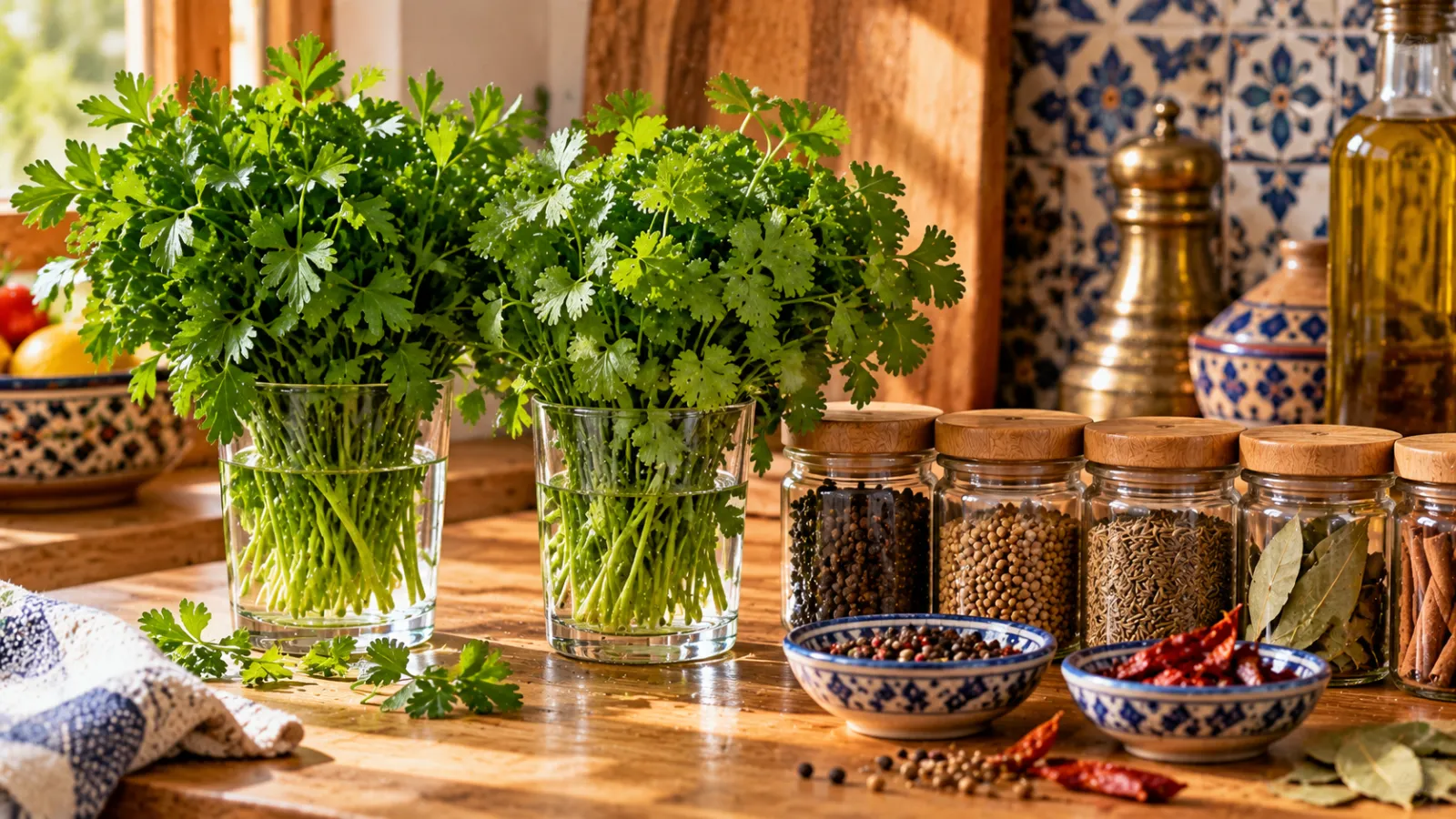
Fresh herbs are one of the quickest ways to make a dish taste bright and finished, but they have a frustrating habit of wilting or turning slimy in the fridge within days. Dried spices have the opposite problem: they seem to last forever, yet quietly lose their flavour on the shelf.
A few simple storage methods solve both problems. With the right approach, a bunch of parsley can last a week or two, and your spice rack can deliver real flavour instead of dusty colour. Here is how to do it.
Soft herbs versus hardy herbs
The first step is knowing which kind of herb you have, because they need different care.
- Soft (tender) herbs have soft stems and delicate leaves: parsley, coriander (cilantro), basil, mint, dill, tarragon and chervil.
- Hardy (woody) herbs have tough, woody stems and sturdier leaves: rosemary, thyme, sage, oregano, marjoram and bay.
Chives sit somewhere in between; they do best wrapped like hardy herbs.
How to store soft herbs: the bouquet method
Treat soft herbs like a bunch of flowers. This keeps the stems hydrated and the leaves crisp.
- Remove any ties or rubber bands and discard wilted or yellow leaves.
- Trim about ½ inch (1 cm) from the bottom of the stems with a sharp knife.
- Stand the herbs in a jar or glass with about 1 inch (2–3 cm) of cold water, so only the stems are submerged.
- Loosely cover the leaves with a plastic bag or a reusable produce bag.
- Store in the fridge, except basil (see below), and change the water every two or three days.
Stored this way, parsley and coriander often last 1–2 weeks, and dill and mint around a week.
Basil is the exception. It is sensitive to cold and its leaves turn black in the fridge. Keep basil in a jar of water on the counter, out of direct sunlight, and use it within a few days.
Wait to wash herbs until just before using them. Excess moisture on the leaves speeds up rotting. If you do wash them ahead, dry them thoroughly in a salad spinner or between towels first.
How to store hardy herbs: the damp towel method
Woody herbs do not drink much water through their stems, so a jar is less useful. Instead:
- Lightly dampen a paper towel or thin clean kitchen cloth. It should be moist, not dripping.
- Lay the herbs in a single layer on the towel and roll them up loosely.
- Place the bundle in a zip-top bag or airtight container, leaving it slightly open or with a little air.
- Store in the crisper drawer of the fridge.
Rosemary, thyme and sage stored this way usually keep for 1–2 weeks, sometimes longer. Check every few days and re-dampen the towel if it dries out.
Freezing herbs in oil
When you have more herbs than you can use, freezing saves them from the bin. Freezing changes their texture, so frozen herbs are best for cooked dishes like soups, stews, sauces and sautés rather than garnishes.
- Wash and dry the herbs thoroughly.
- Chop them finely, removing tough stems from hardy herbs.
- Pack the chopped herbs into an ice cube tray, filling each cube about two-thirds full.
- Pour olive oil or melted butter over the top to cover the herbs completely.
- Freeze until solid, then pop out the cubes and store them in a labelled freezer bag.
The oil protects the herbs from freezer burn and browning. Use the cubes within about 6 months, dropping them straight into a hot pan to start a dish. Hardy herbs, parsley, coriander and dill all freeze well. You can also blend basil with oil into a smooth purée and freeze that, which works well as a pesto base.
For food safety, keep herb-and-oil mixtures frozen or refrigerated and use refrigerated batches within a few days. Do not store fresh herbs or garlic covered in oil at room temperature.
Dried spices: whole versus ground
Dried spices do not spoil in a way that makes them unsafe, but they lose their aroma and flavour over time as their essential oils evaporate. How fast depends largely on whether they are whole or ground.
- Whole spices (peppercorns, cumin seeds, coriander seeds, cinnamon sticks, cloves, nutmeg) keep their flavour for roughly 2–3 years or more because the oils are sealed inside.
- Ground spices (paprika, ground cumin, chilli powder, turmeric, ground ginger) are at their best for about 6 months to 1 year, because grinding exposes more surface area to air.
- Dried leafy herbs (oregano, thyme, basil) generally stay flavourful for about 1 year.
Buying whole spices and grinding small amounts as needed in a spice grinder or mortar and pestle gives you the freshest flavour. If you buy ground, choose smaller jars you will use up within a year.
How to store spices: avoid light, heat, air and moisture
Four things shorten the life of dried spices: light, heat, air and moisture.
- Use airtight containers. Glass jars with tight lids or the original sealed containers both work well.
- Keep them in a cool, dark cupboard or drawer. A rack on the wall next to a sunny window or directly above the stove is convenient but exposes spices to both light and heat.
- Keep them dry. Do not shake spices straight from the jar over a steaming pot, as steam gets inside and causes clumping. Measure into a spoon or your hand away from the pan instead.
- Label jars with the purchase date so you know what to use first.
Paprika, chilli powder and other red spices can be kept in the fridge to help keep their colour, as long as the container is airtight.
How to tell if a spice is stale
Use your senses. Rub a pinch of the spice between your fingers or crush a whole spice, then smell it.
- A fresh spice has a strong, immediate aroma. A stale one smells faint, dusty or of nothing at all.
- Colour fades over time; bright red paprika turns brownish and green dried herbs turn grey or khaki.
- Taste a tiny amount. If the flavour is weak, you would need far more to get any effect, so it is time to replace it.
Discard any spice that shows signs of moisture, mould or insects.
Toasting whole spices for more flavour
Toasting whole spices before grinding or adding them to a dish wakes up their aromatic oils and gives a deeper, nuttier flavour.
- Heat a dry, heavy pan over medium-low heat.
- Add the whole spices in a single layer.
- Toast for 1–3 minutes, shaking the pan often, until fragrant and a shade darker. Small seeds like cumin toast faster than larger ones like coriander.
- Tip them onto a plate immediately so they do not keep cooking and burn, then grind once cool.
Burnt spices taste bitter, so take them off the heat as soon as they smell toasted.
Quick tips
- Buy fresh herbs with perky leaves and no dark or slimy spots.
- Use soft herb stems too; coriander and parsley stems are full of flavour in sauces and stocks.
- Do a spice clear-out once a year and replace anything that has lost its aroma.
Good storage means less waste and more flavour in every meal. Set up a jar for your soft herbs, wrap the hardy ones, and give your spice cupboard a quick sniff test. If you have a bunch of herbs that needs using up, ask the Smart Chef for a recipe built around what you have.
Reader Comments (0)
Have thoughts on this article?
Sign in to leave a comment or share your experience.
No comments yet
Be the first to share your thoughts on this article!