How to Make Fluffy Couscous the Traditional Way

Chef Karim
CHEF
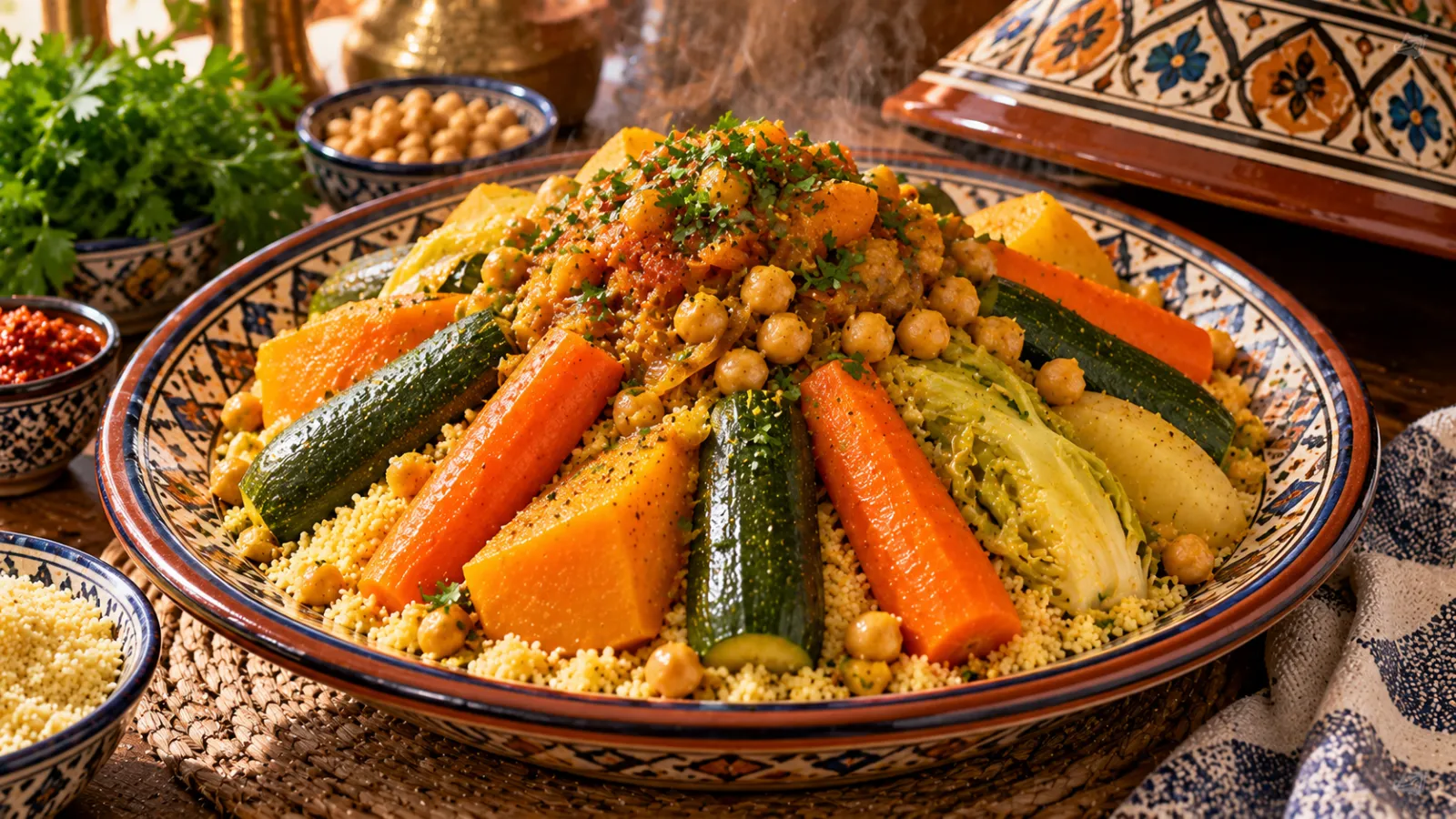
Couscous is made from tiny rolled granules of semolina, and in Morocco, Algeria and Tunisia it is a much-loved dish, often made in a large platter for family gatherings. Good couscous is light and separate, with each grain tender and none of the stodgy clumps that come from simply drowning it in boiling water.
The traditional way to achieve that is steaming, usually more than once, in a two-part pot called a couscoussier. It takes longer than the packet method, but the result is noticeably fluffier. Below you will find both methods, the ratios that matter, and how to serve couscous with a classic seven-vegetable stew.
Know your couscous
Almost all couscous sold in supermarkets in the US, UK, Canada and Australia is pre-steamed and dried, often labelled "instant". It only needs to rehydrate, which is why the packet instructions take five minutes. You can still steam it the traditional way, and it makes a real difference to texture.
- Fine and medium couscous are the most common for Moroccan dishes.
- Whole wheat couscous works the same way but may need a little extra water.
- Pearl or giant couscous is a different product. It is toasted pasta and is boiled, not steamed, so the methods below do not apply.
The quick method (done well)
If you are short on time, the absorption method is fine, as long as you do a few things the packet does not tell you.
- Measure 1 cup (about 180 g) of couscous into a wide, shallow bowl. This serves 3 to 4 as a side.
- Drizzle over 1 tablespoon olive oil and 1/2 teaspoon salt, then rub the grains between your palms until every grain is coated. This is the step that prevents clumping.
- Pour over 1 cup (240 ml) of boiling water or stock, a 1:1 ratio by volume. For whole wheat, use about 1 1/4 cups (300 ml).
- Cover tightly with a plate or a tea towel and leave for 5 to 7 minutes.
- Uncover and fluff with a fork, then with your fingertips once it is cool enough, breaking up any lumps. Stir in 1 tablespoon butter if you like.
Using a wide bowl matters: a deep, narrow one leaves the bottom layer wet and the top dry.
The traditional method: steaming in a couscoussier
A couscoussier is a tall pot with a perforated steamer basket that sits snugly on top. The stew or broth simmers in the bottom while the couscous steams above it, absorbing aroma as it cooks. If you do not own one, a metal colander or steamer basket that fits tightly over a large pot works well; line it with a thin cloth if the holes are large.
The following quantities serve 6. You need 3 cups (about 540 g) of couscous.
Step 1: Moisten and oil
Spread the couscous in a large, wide bowl or tray. Sprinkle over about 1/2 cup (120 ml) of cold water mixed with 1 teaspoon salt, rubbing the grains between your hands as you go. Then add 2 tablespoons olive oil or neutral oil and rub again until the grains feel separate and lightly coated. Leave for 10 minutes.
Step 2: First steaming
Bring the stew or plenty of water in the bottom pot to a steady simmer. Seal the gap between pot and basket if steam escapes; a strip of damp cloth wrapped around the join is the traditional fix. Tip the couscous loosely into the basket without pressing it down. Once you see steam rising through the top of the grains, steam uncovered for 15 minutes.
Step 3: Rake, water and rest
Tip the couscous back into the bowl. Let it cool for a minute, then gradually sprinkle over another 1/2 cup (120 ml) of water, raking with a fork and then your hands to break every lump. Leave it to rest for 10 minutes so the grains absorb the water.
Step 4: Second and third steaming
Return the couscous to the basket and steam again for 15 minutes from when the steam appears. For the lightest result, repeat the raking with a final 1/4 to 1/2 cup (60 to 120 ml) of water and steam a third time for 10 to 15 minutes. Pre-steamed supermarket couscous is usually done after two steamings; taste a few grains and stop when they are tender with no chalky centre.
Step 5: Butter and fluff
Turn the hot couscous into a wide dish, add 2 to 3 tablespoons butter in small pieces, and work it through with a fork. Taste for salt.
Ratios at a glance
- Quick method: 1 part couscous to 1 part boiling liquid by volume, plus 1 tbsp oil per cup.
- Steaming method: roughly 1/3 cup (80 ml) of water per cup of couscous at each raking stage, added a little at a time.
- Portions: about 1/2 cup (90 g) dry couscous per person for a main, 1/4 to 1/3 cup (45 to 60 g) for a side.
Serving with seven-vegetable couscous
Couscous with seven vegetables is one of Morocco's best-known couscous dishes, and in many homes couscous is a traditional Friday lunch shared by the whole family. The exact vegetables change with the season and the cook, but a typical mix includes:
- Carrots and turnips, cut into long batons
- Courgettes (zucchini)
- Pumpkin or butternut squash, in large chunks
- Cabbage, in wedges
- Tomatoes and onions, which form the base of the broth
- Chickpeas, soaked and cooked or tinned
The broth is usually built on lamb, beef or chicken with onion, tomato, ginger, turmeric, black pepper, a little saffron and a bundle of parsley and coriander, though a vegetable-only version is just as good. Hard vegetables go in first and softer ones like courgette and pumpkin for the last 20 minutes or so, so everything finishes tender but intact.
To serve, mound the couscous on a large platter and make a well in the centre. Place the meat in the well, arrange the vegetables over and around it, and ladle some broth over the couscous to moisten it. Offer extra broth in a bowl at the table. A popular finishing touch is a sweet topping of onions and raisins slowly cooked with cinnamon and honey.
Common mistakes
- Skipping the oil rub. Uncoated grains stick together as soon as they meet water.
- Adding all the water at once during steaming. Add it gradually and rake as you go.
- Packing the steamer. Pressed-down couscous will not steam evenly; keep it loose.
- Leaving it to sit. Couscous firms up as it cools. Fluff it again with a little butter or broth just before serving, and refrigerate leftovers within 2 hours.
Once you have tasted properly steamed couscous, it is hard to go back to the five-minute version for special meals. For stews, tagines and broths to pile on top, take a look at our Moroccan and Arabic recipes.
Reader Comments (0)
Have thoughts on this article?
Sign in to leave a comment or share your experience.
No comments yet
Be the first to share your thoughts on this article!