Baking Basics: Why Accurate Measuring Matters and How to Do It

Chef Karim
CHEF
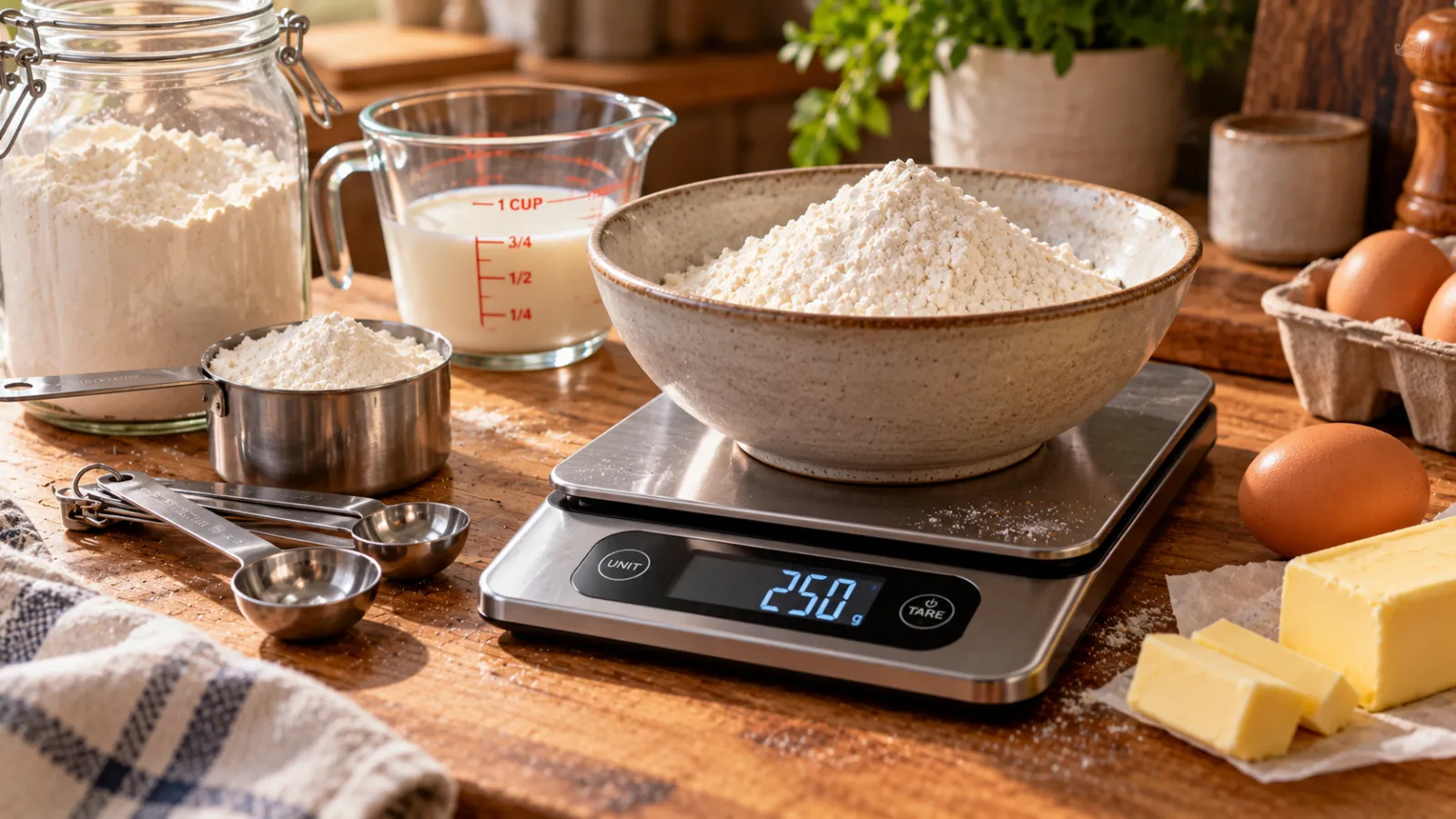
Cooking forgives a heavy hand. Add a little extra garlic to a stew or an extra splash of stock to a sauce and it still tastes good. Baking is less flexible. A cake, a loaf of bread or a batch of cookies is a small piece of chemistry, and the ratio of flour to fat, sugar, liquid and leavening decides whether you get a tender crumb or a dense brick.
The good news is that accurate measuring is not difficult. It comes down to a few habits: how you fill a measuring cup, whether you use a scale, the temperature of your ingredients and the true temperature of your oven. Get those right and most recipes will turn out the way the writer intended.
Why small errors add up in baking
Flour is the ingredient most often measured wrong. If you scoop a cup straight from the bag, the cup packs the flour down and you can easily end up with 150 g or more instead of the 120–130 g most recipes expect. That is an extra 20–25 percent of flour, which soaks up liquid and gives you dry cookies, tough muffins and cakes that dome and crack.
Leavening is even less forgiving. A recipe might call for 1 teaspoon of baking soda for an entire cake, so a heaped spoon instead of a level one can leave a soapy, metallic taste and cause the cake to rise fast and then sink. Salt behaves the same way: a little too much is noticeable in a sweet bake.
None of this means you need laboratory precision. It means being consistent, so the recipe you liked last week tastes the same next week.
How to measure flour with cups: spoon and level
If you are using measuring cups, the spoon-and-level method gets you closest to what most recipe writers use.
- Stir or fluff the flour in its container with a spoon to loosen it.
- Spoon the flour lightly into a dry measuring cup until it mounds above the rim. Do not tap or shake the cup.
- Sweep a straight edge, such as the back of a knife, across the top to level it.
Use dry measuring cups (the ones you fill to the brim) for flour, sugar, oats and cocoa, and a liquid measuring jug with a spout for milk, water and oil. Read the liquid jug at eye level on a flat counter, because looking down from above makes the line look higher than it is.
A few ingredients are measured differently. Brown sugar is usually packed firmly into the cup so it holds its shape when turned out. Powdered (icing) sugar and cocoa powder clump, so sift them if the recipe asks. Sticky ingredients like honey and syrup slide out cleanly if you lightly oil the cup or spoon first.
Why a kitchen scale is the best tool you can buy
A digital scale takes the guesswork out completely. A gram of flour is a gram of flour, no matter how it was packed. Scales are inexpensive, take up little space and actually save washing up, because you can weigh everything into one bowl.
To use one, place your bowl on the scale, press the tare (or zero) button, add the first ingredient until you hit the target weight, press tare again and add the next. Most scales switch between grams and ounces; grams are more precise for baking because the units are smaller.
Weighing is especially worth it for bread, macarons, pastry, and any recipe you want to scale up or down. Doubling 250 g is easier than doubling 1¾ cups.
Cup-to-gram conversions for common baking ingredients
These are typical values used by many recipe writers. Different sources vary slightly, so if a recipe gives its own weights, follow those.
- All-purpose (plain) flour: 1 cup spooned and levelled = about 125 g
- Bread flour: 1 cup = about 130 g
- Whole wheat flour: 1 cup = about 120 g
- Granulated (white) sugar: 1 cup = 200 g
- Brown sugar, packed: 1 cup = about 210 g
- Powdered (icing) sugar: 1 cup = about 120 g
- Butter: 1 cup = 227 g (½ cup = 113 g; 1 tablespoon = about 14 g)
- Cocoa powder: 1 cup = about 85 g
- Rolled oats: 1 cup = about 90 g
- Milk or water: 1 cup = 240 ml (about 240 g)
Note that a US cup is 240 ml, while some recipes from Australia and elsewhere use a 250 ml cup. Australian tablespoons are 20 ml rather than 15 ml. If a recipe comes from another country and the results seem off, check which standard it uses.
Room-temperature ingredients and why they matter
When a recipe says "room temperature butter," it is not being fussy. Softened butter traps air when you beat it with sugar, and those tiny air pockets help a cake rise and give cookies a lighter texture. Butter that is too cold will not cream; butter that is melting will not hold air at all.
Properly softened butter is around 65–68°F (18–20°C). It should give slightly when pressed with a finger, leaving a dent, but still feel cool and hold its shape. Leave it out for 30–60 minutes depending on your kitchen, or cut it into small cubes so it softens faster.
Eggs and dairy should also be at room temperature for most cakes and batters. Cold eggs can make creamed butter seize and look curdled. To warm eggs quickly, put them in a bowl of warm (not hot) tap water for 5–10 minutes. Milk or buttermilk can be microwaved in short bursts just to take the chill off.
Oven temperature: thermometers and preheating
Ovens are often off by 15–25°F (about 10–15°C) or more, and the dial does not tell you. An inexpensive oven thermometer that hangs from the rack shows the real temperature. Put it in the centre of the oven, preheat to 350°F (180°C), wait 20 minutes and read it. If it is consistently high or low, adjust the dial to compensate.
Always preheat fully before baking. Most ovens need 15–20 minutes to reach temperature, even if the light or beep says it is ready sooner. A cake that goes into a cold oven sets unevenly and may not rise properly.
A few more oven habits help:
- Bake on the middle rack unless the recipe says otherwise.
- Avoid opening the door during the first two-thirds of baking time, as each opening lets heat escape.
- If your oven has hot spots, rotate pans halfway through.
- For fan (convection) ovens, reduce the temperature by about 25°F (15–20°C) from a conventional recipe, and start checking a little early.
Common measuring mistakes
- Scooping flour straight from the bag with the measuring cup.
- Using a liquid jug for flour or a dry cup for milk.
- Heaping teaspoons of baking soda, baking powder or salt.
- Forgetting to tare the scale after adding the bowl.
- Using butter straight from the fridge when the recipe needs it softened.
- Trusting the oven dial without ever checking it.
Accurate measuring is one of those small changes that makes an outsized difference. Pick up a scale and an oven thermometer, practise the spoon-and-level method, and give your ingredients time to come to temperature. Then put those habits to work with our baking recipes and see how much more reliable your results become.
Reader Comments (0)
Have thoughts on this article?
Sign in to leave a comment or share your experience.
No comments yet
Be the first to share your thoughts on this article!